
Holy Faith Convent, Couva
Our History
A Living Legacy
"Though rooted in Catholic tradition, Holy Faith Convent has always held an ecumenical spirit, welcoming students of other faiths to learn and practice alongside their peers."
Our Story
The Beginning
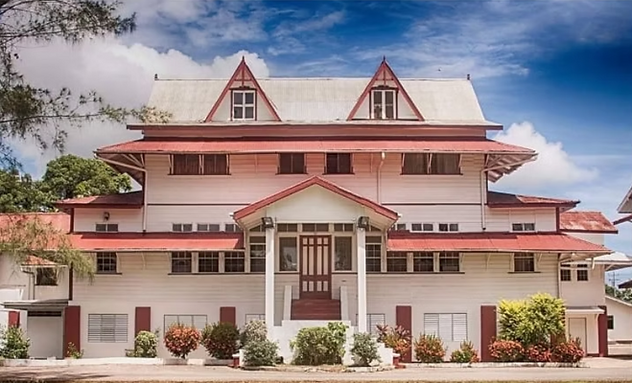
Seeing the need for a secondary school in the Couva district, Archbishop Count Finbar Ryan suggested the Holy Faith Sisters take up the cause. The Irish sisters purchased the Exchange House — 4½ acres of bush and swampland, with a once-beautiful house in need of extensive repair — for $20,000, and set about building a school and convent.
In January 1951, the sisters welcomed their first 50 students. Most families in the area worked in the sugar industry, and it was the daughters of cane farmers and estate managers who first benefited from the new school. Students wore crisp white bodices with a maroon badge on the sleeve, white socks and shoes, and maroon overalls and berets. Tuition was $16 a term, though College Exhibitions opened the door for bright girls from less well-off families too.
Even in these early years, the curriculum was ambitious: Latin, Health Science, Maths, Geography, Religious Education, Domestic Science, Art, English, and French, alongside elocution, dancing, drama, and the Classics — reflecting the sisters' European background.
The 1950s — A Catholic Foundation
Faith shaped every part of school life. Mornings began with prayer, the Angelus was recited at 12:30, and the day closed with the Rosary. Every child learned the catechism, and the whole school attended Mass monthly — dressed for the occasion in off-white sea island cotton, pearl buttons, and Peter Pan collars.
With only four nuns and a small student body, the school had a close, family feel. Students and teachers worshipped together, sang together in Latin, and grew genuinely close. It was in this spirit that Sister M. Magdalena wrote the school song — a piece that would carry the meaning of the Convent forward for generations. Students showed their respect for the sisters by curtsying when they passed — a small gesture of the warmth and formality that defined the era.
The Magdalena Mac Bride wing was added in 1953, and the school's first lay teachers, Mary Christian and Grace Lucas, joined the staff.
The 1960s — Growth and Change
Free education and the introduction of Common Entrance in 1962 brought a wave of new students — the population grew to around 300. The Caroni Estate donated more land, allowing the Mac Bride building to expand and the school's first science labs to be built.
Growth meant more staff, including the school's first male teacher, David Naranjit, brought in to teach the newly introduced sciences. That same year, A-Level classes began — with just three students in the very first cohort.
As the student body grew, the Consilio-Harte Block was built, and in 1966 a prefect system was introduced, with prefects recognisable by their maroon skirts and white shirts.
The 1970s — A New Era of Leadership
In 1973, Mrs. P. Punch — a former pupil — became the first lay Principal in the school's history, a milestone moment for Holy Faith Convent.
Extracurricular life flourished: the Guitar, Science, Creative Writing, and Drama Clubs, 4H, and Girl Guides all began in this decade, giving students new ways to grow beyond the classroom. It was also a period of change within the Church, as the Ecumenical movement began to shape religious life at the school — and, notably, students of this era faced no age restrictions on sitting exams. As the local business sector expanded, Economics and Principles of Business were added to the curriculum to prepare students for the world ahead.
The 1980s — Building for the Future
The 1980s brought the St. Brigid's Wing, adding a library, offices, a staff room, and five new classrooms — plus, to the delight of the student body, a popcorn machine and an ice cream freezer. A sheltered walkway connected the Mac Bride building to the office.
A new Convent Residence was built in 1986, and the West Annex was renovated in 1989 to house typing and computer rooms, with the cafeteria relocating there too. Hindi joined the curriculum, swimming became a highlight for Form 3 students, and the school competed in Intercol Hockey and Cricket, Zonal Sports, and the Trintoc Public Speaking, Debating, and Drama Festivals.
The decade also brought a bittersweet farewell, as pioneering Sisters Magdalena and Consilio returned home to Ireland after decades of service, alongside PE teacher Mrs. Pemberton — three women whose dedication shaped the school's earliest years.
By this point, Holy Faith Convent had grown from a single convent building into a seven-building campus — a testament to four decades of growth, faith, and community.
A Living Legacy
Though rooted in Catholic tradition, Holy Faith Convent has always held an ecumenical spirit, welcoming students of other faiths to learn and practice alongside their peers. As the school entered the age of computers, it carried forward the same spirit that guided its first 50 students in 1951 — ready, as always, for whatever comes next.
Source: The Past Pupils' Association